

Philosophy
The theory behind the Dynamic AI-First Computing Engine.
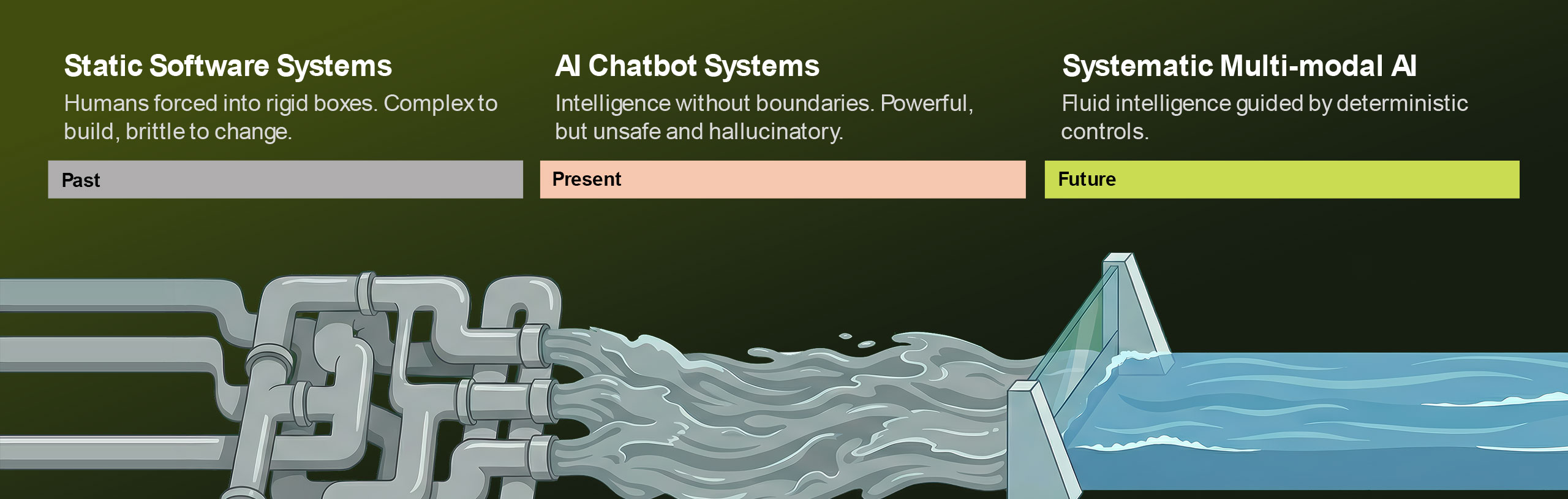
Software development has historically been Static. Developers wrote rigid if/else statements to define exactly how a user flows through a system. It was safe, but brittle.
The arrival of Generative AI introduced Dynamic computing. LLMs can handle infinite variations of user input. However, they are probabilistic—they can hallucinate, break rules, and leak data. They are powerful, but chaotic.
The Hybrid Approach
Iqra AI is built on a specific philosophy: Probabilistic Intent driving Deterministic Action.
We believe the future of software is not "Pure Code" nor "Pure AI", but a hybrid architecture that leverages the strengths of both.
The River and The Dam
Think of user interaction as a river.
- The River (AI): We let the AI flow naturally. It handles the nuances of language, dialect, and intent. We do not force the user into a rigid IVR menu.
- The Dam (Control Layer): To generate value, that energy must be channeled. We place strict, deterministic gates—Action Flows and FlowApps through Visual Script Builder—that the AI must pass through to execute tasks.
This architecture ensures that while the conversation is dynamic, the business outcome (e.g., booking a database slot, processing a payment) is 100% reliable.
Core Pillars
AI-First Routing
The Agent is not just a script reader; it is a Router. It assesses the state of the conversation and decides which tool or flow to trigger next, breaking free from linear "Decision Trees."
Deterministic Sub-routines
Business logic cannot be "hallucinated." When the AI decides to "Calculate Loan Interest," it hands off control to a FlowApp—a strict code block that executes the math precisely and returns the result.
The Clean Room
We believe AI should never touch sensitive secrets. Our Secure Session architecture creates a wall between the LLM and your PII/PCI data, ensuring compliance without sacrificing intelligence.
Democratized Engineering
Finally, we believe that building this "Superhuman Employee" shouldn't require a team of backend engineers. By visualizing this complex architecture in a Low-Code Builder, we empower domain experts to build systems that previously required millions of dollars in R&D.